


- Home
- Products
- Raw Material Processing & Trading
- JUNG-YI STEEL CO., LTD.
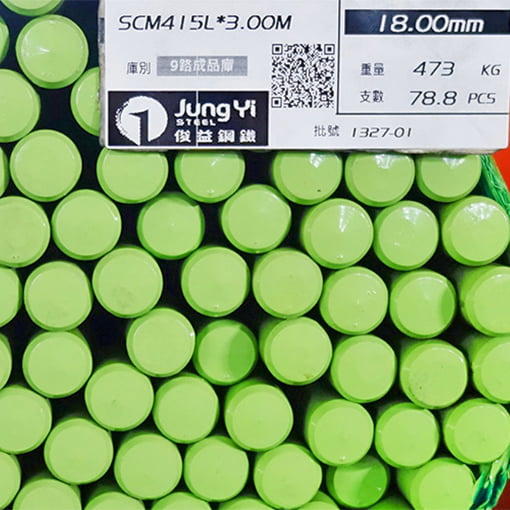
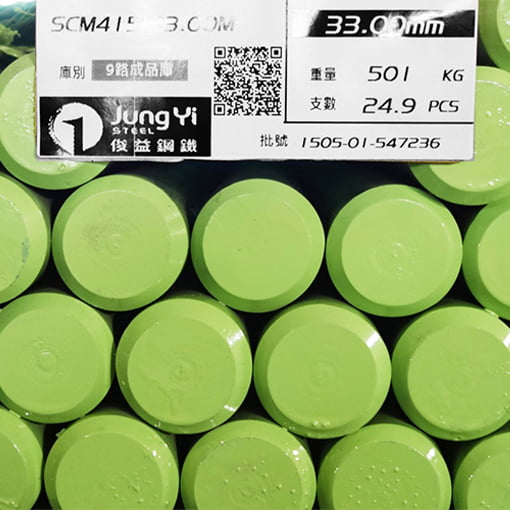
- Green Cross Alloy Sharpener (Lead) SCM415L

JUNG-YI STEEL CO., LTD.
Green Cross Alloy Sharpener (Lead) SCM415L
Share:



- Free cutting steel, alloy free cutting
- Product Description
- Material symbol conversion for sulfur and sulfur-composite free-cutting steel (SUM): JIS old and new reference table
Free cutting steel, alloy free cutting
Adding alloying elements such as lead (Pb), sulfur (S), and phosphorus (P) to steel, with sulfur being the most commonly used to form MnS, can cause the chips produced during machining to become fine flakes or short, discontinuous chips. These elements also have a lubricating effect, increasing machinability and surface finish. Steels that are easier to machine due to the addition of lead, sulfur, and phosphorus are called free-machining steels.Adding 0.1-0.3% lead to carbon steel or alloy steel can further improve the machinability of the steel. This is because lead does not dissolve in iron in any state, but is uniformly distributed in the steel in the form of individual granules. During cutting, lead forms a solid lubricant, making the chips easy to break and not affecting its mechanical properties.
Free-machining steel can generally be divided into two types based on the elements added:
- sulfur-based free-cutting steel
- Lead-based free-cutting steel
Product Description
SUM11,22,22L
This is a type that emphasizes machinability and is also known as low-carbon free-cutting steel. This steel is chosen when machinability is more important than mechanical properties (such as strength).
SUM31,32,41,42,43,31L
It has a medium carbon content and high strength, and is also known as medium carbon free-cutting steel. SUM31 has the same strength as SS400, while SUM41, 42, and 43 have the same strength as S35C, S40C, and S45C, respectively. It is used after heat treatment (tempering). The proportion of Mn (manganese) is increased to prevent a decrease in strength due to S (sulfur). Composite free-cutting steel (also known as S free-cutting steel) has an orientation in its mechanical properties. The higher the S (sulfur) content, the slightly worse the ductility and toughness perpendicular to the rolling direction. Pb free-cutting steel, with the addition of Pb as a free-cutting element, has good ductility and, due to its uniform elemental distribution, is not as anisotropic as S free-cutting steel. However, since the mechanical properties of this product depend on the melting point of Pb, the mechanical properties decrease at temperatures above 327°C. Generally, lead-free steel is used after heat treatment such as quenching and tempering.
This is a type that emphasizes machinability and is also known as low-carbon free-cutting steel. This steel is chosen when machinability is more important than mechanical properties (such as strength).
SUM31,32,41,42,43,31L
It has a medium carbon content and high strength, and is also known as medium carbon free-cutting steel. SUM31 has the same strength as SS400, while SUM41, 42, and 43 have the same strength as S35C, S40C, and S45C, respectively. It is used after heat treatment (tempering). The proportion of Mn (manganese) is increased to prevent a decrease in strength due to S (sulfur). Composite free-cutting steel (also known as S free-cutting steel) has an orientation in its mechanical properties. The higher the S (sulfur) content, the slightly worse the ductility and toughness perpendicular to the rolling direction. Pb free-cutting steel, with the addition of Pb as a free-cutting element, has good ductility and, due to its uniform elemental distribution, is not as anisotropic as S free-cutting steel. However, since the mechanical properties of this product depend on the melting point of Pb, the mechanical properties decrease at temperatures above 327°C. Generally, lead-free steel is used after heat treatment such as quenching and tempering.
Material symbol conversion for sulfur and sulfur-composite free-cutting steel (SUM): JIS old and new reference table
| 2008 | 1983 | 1970 | 1970 |
|---|---|---|---|
| - | - | - | Summation 1A |
| - | - | - | SUM1B |
| SUM32 | SUM32 | SUM32 | SUM2 |
| - | - | - | SUM3 |
| - | - | - | SUM4 |
| - | - | - | SUM5 |
| - | SUM11 | SUM11 | - |
| - | SUM12 | SUM12 | - |
| SUM21 | SUM21 | SUM21 | - |
| SUM22 | SUM22 | SUM22 | - |
| SUM22L | SUM22L | SUM22L | - |
| SUM23 | SUM23 | SUM23 | - |
| SUM23L | SUM23L | SUM23L | - |
| SUM24L | SUM24L | SUM24L | - |
| SUM31 | SUM31 | SUM31 | - |
| SUM31L | SUM31L | SUM31L | - |
| Total 41 | Total 41 | Total 41 | - |
| SUM42 | SUM42 | SUM42 | - |
| SUM43 | SUM43 | SUM43 | - |
| SUM25 | SUM25 | - | - |
Contact Us
If you have any suggestions or advice, please leave your valuable information and we will reply to you as soon as possible.